
Introduction
Throughout the assessment process, it is in the interests of all parties to ensure that the evidence provided for assessment is relevant, authentic, valid, safe, and reliable to ensure judgement by the assessor is accurate. Where Assessors are unsure whether the Learner has achieved the standards, the assessor will be unable to agree that the Learner has achieved and will provide feedback that the criteria has not yet been met. In that sense there are no halfway points: The Learner has either achieved a unit of credit or not yet achieved.
- A decision that the Learner has achieved – will be verified as part of the Quality Assurance.
- A decision that the learner has not achieved – can be appealed by the learner.
When Appeals May Be Lodged
Appeals cannot be made against the professional judgement of the Assessor, but rather the conduct of an assessment. Appeals regarding the conduct of an assessment may be made if:
- the learner has not had access to assessment against relevant standards; or recognition of prior learning (RPL).
- if the learner wishes to appeal against concerns raised by the centre regarding plagiarism and collusion but not if this has been determined by the awarding organisation.
- the judgement of the assessor against RPL assessment.
- the learner has not received reasonable notice prior to a simulated assessment (assessment will normally take place during normal working procedures).
- the conditions of assessment are/were not appropriate.
- the learner’s performance has been adversely affected by illness or other outside circumstances.
- the relevance, authenticity, validity or reliability of the evidence are in question.
Taking Action
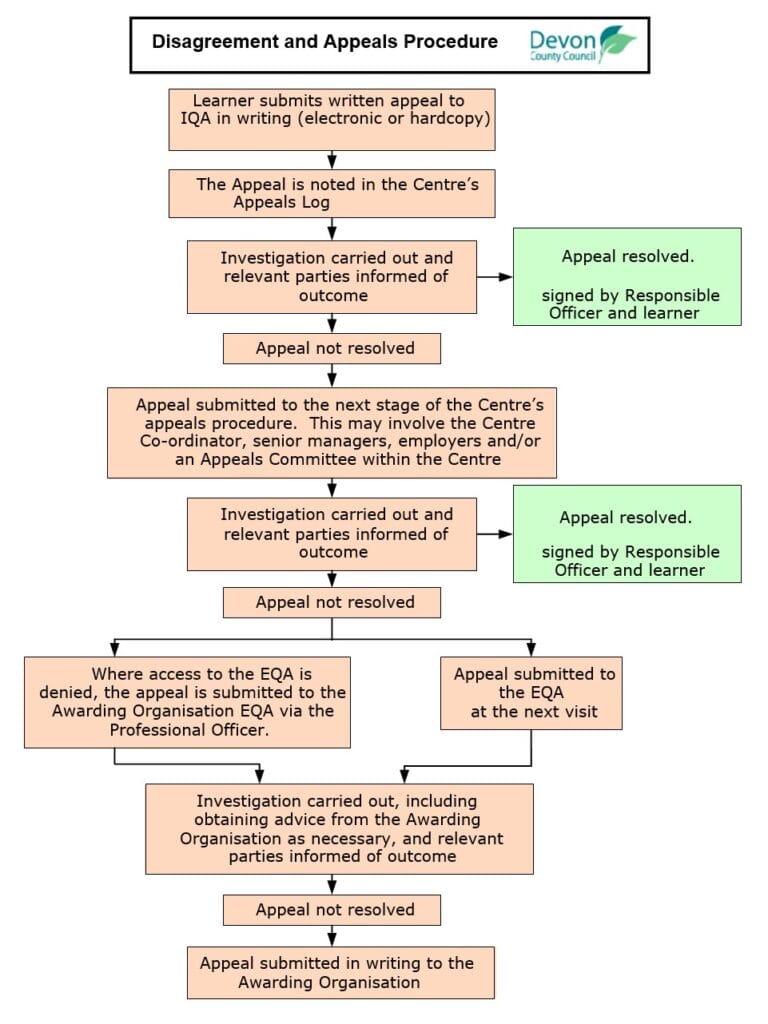
The first step is to refer the concern to the Assessor. If the matter is not resolved, then the next point of contact concerning appeals should be the Internal Quality Assurer (IQA).
- A learner who is unhappy with the assessment decision must express their concern in writing to the IQA within 5 working days of the decision being made.
- When the appeal is received, it must be noted on the Centre’s Appeals Log and allocated a reference number which must be used in all paperwork relating to the appeal.
- The IQA must look at the assessment queried and if possible resolve the problem. The IQAs action must be confirmed in writing to the learner within 10 working days from the receipt of the learner’s appeal.
- If the learner remains dissatisfied with the IQAs decision they can request that the centre Quality Assurance Coordinator (Q.A.C.) reviews, if still unhappy the Q.A.C will refer the appeal to the External Quality Assurer (EQA). The Centre Co-ordinator will set an appeal date. This will be within 20 working days of referral to the EQA. The EQA will also be notified that an appeal has been lodged.
- Appeals will be heard by a panel consisting of two IQAs. No one involved in the original assessment decision will be on the panel as it is essential that the panel are as objective and independent as possible.
Possible Outcomes of an Appeal
The outcome of an appeal may be:
- confirmation of the original decision
- instructions for a re-assessment by another assessor, or in a different context
- a recommendation that the assessment decision be reconsidered.
Once the appeal has been resolved and all parties are satisfied with the outcome, this must be confirmed in writing and signed by the Q.A.C. and countersigned by the learner signifying that s/he understands and agrees with the action to be taken.
Appeals that cannot be resolved in the Centre
If the appeal cannot be resolved within the Centre, it can be referred either:
- to the Awarding Organisation EQA at the next visit, or if this is not possible,
- to the EQA at the Awarding Organisation headquarters.
An investigation is then carried out by the Awarding Organisation who will seek advice from the Chief Verifier as necessary. The relevant parties involved in the appeal will be informed of the outcome of this investigation.
If the appeal remains unresolved, it must be submitted in writing to the Awarding Organisation by the Centre.
Reviewed by CIAG Team Leader (RP)
Date Reviewed 28/02/25
Next review date 01/03/26
Location The Kennaway Centre, Exmouth
This Policy will be reviewed every year or as changes are deemed necessary by senior management.